Strategy, creative thinking, industry perspective, and lessons from the work.
Work With Us ↗You're posting three times a week. You've got a content calendar. You're consistent. And you're still not seeing results.
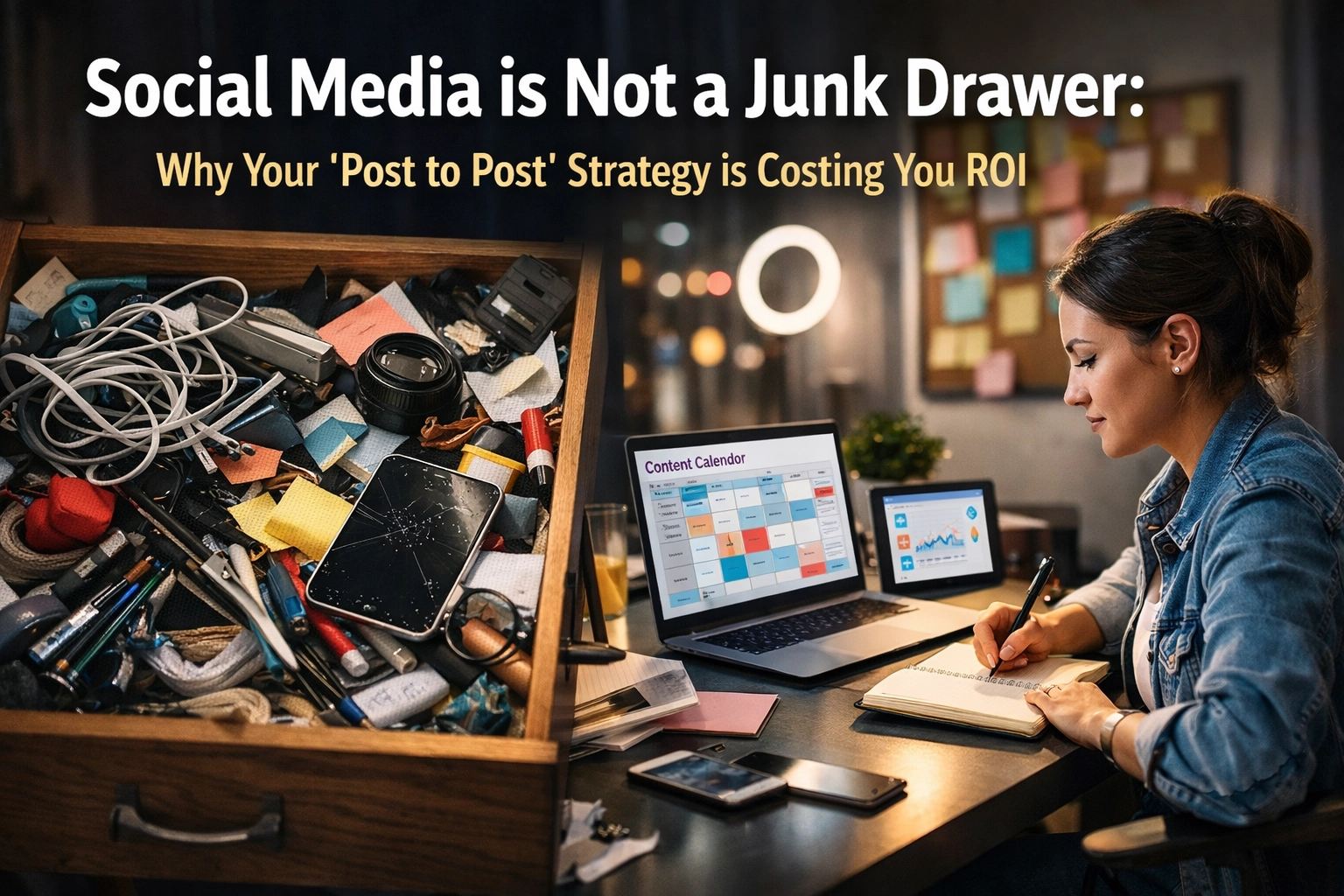
Here's the uncomfortable truth: consistency without strategy is just expensive noise. When you treat social media like a junk drawer, tossing in product announcements, team photos, motivational quotes, and whatever feels relevant that day, you're not building momentum. You're building clutter.
And that clutter is costing you real money.
The Hidden Cost of "Post to Post" Thinking
Every post you publish without a clear purpose is a small investment with no return. You're paying for:
- Design time to make it look professional
- Copywriting hours to craft captions
- Management resources to schedule and monitor
- Paid boost budget when organic reach inevitably falls flat
But here's what you're not getting: conversions. No leads. No strategy calls. No one moving closer to hiring you.
Why? Because random posting doesn't guide anyone anywhere. It just fills space.

Think of it this way: if someone lands on your Instagram or LinkedIn profile right now, what would they learn about your business? That you exist? That you're active? Great. But do they understand what problem you solve, who you solve it for, and why they should care?
If your answer is "probably not," you've got a junk drawer.
You're Chasing Metrics That Don't Matter
Let's talk about vanity metrics. Likes. Comments. Shares. Follower count.
They feel good. They're easy to track. And they mean almost nothing.
You don't pay your bills with likes. You pay them with clients. And the post with 15 likes that drove someone to book a discovery call is worth infinitely more than the post with 300 likes that did nothing.
But most businesses can't tell the difference because they're not tracking the right things. They're measuring activity instead of outcomes. They're confusing "engagement" with "results."
Here's what actually matters:
- Did someone click your link?
- Did they fill out your contact form?
- Did they watch your video all the way through?
- Did they move from awareness to consideration?
If your posts aren't mapped to those objectives, you're just creating content for content's sake. And that's expensive theater.
Random Posting Kills Your Brand Authority
Here's something most people don't realize: inconsistency in messaging is worse than inconsistency in posting.
You can post twice a month and still build authority, if every post reinforces who you are, what you do, and why you're the right choice. But if you post every day and your content is all over the place? You've just trained your audience to ignore you.
One day you're sharing a client win. The next day it's a meme. Then a team lunch photo. Then a blog link with no context. Then a motivational quote.
What's your audience supposed to take away from that? What's the throughline? What problem are you solving?

Authority comes from repetition and clarity. It comes from showing up with the same core message, told in different ways, until your audience can't not associate you with that solution.
Random posting undermines that. It dilutes your positioning. It makes you forgettable.
What a Strategy-First Approach Actually Looks Like
Here's the shift: stop thinking in posts. Start thinking in systems.
A strategy-first approach means every piece of content serves a purpose in a larger plan. It's not about filling a calendar: it's about moving people through a deliberate journey from awareness to conversion.
Start here:
1. Define Your Objective (Not Your Vibe)
"Increase engagement" is not an objective. It's a vanity metric wrapped in a goal.
A real objective sounds like this:
- Generate 10 qualified leads per month through social content
- Drive 50 clicks to our case study page
- Book 5 discovery calls from LinkedIn outreach
Notice the difference? These goals are specific, measurable, and tied to revenue.
2. Map Content to the Buyer Journey
Your audience is at different stages of awareness. Some people don't know they have a problem yet. Some know they have a problem but don't know solutions exist. Some are comparing you to competitors.
Your content needs to address all three stages:
- Awareness posts: educate on the problem (no pitch)
- Consideration posts: position your approach as the solution (soft pitch)
- Conversion posts: make the ask (strong CTA)
If all your content lives in one stage, you're leaving revenue on the table.

3. Build Content Themes, Not One-Offs
Instead of asking "what should we post this week," ask "what do we need people to believe about us in the next 90 days?"
Then create content pillars that reinforce those beliefs. For example:
- Pillar 1: Strategy before production (we're not just videographers: we're business partners)
- Pillar 2: ROI-focused storytelling (our work drives measurable results)
- Pillar 3: Process transparency (you'll know exactly what to expect)
Every post you create should ladder up to one of those pillars. That's how you build authority. That's how you stay on-message.
4. Track What Matters
Stop celebrating likes. Start tracking conversions.
Set up a simple tracking system:
- Click-through rate on links in posts
- Form submissions from social traffic
- Discovery calls booked from social touchpoints
- Time-on-page for blog posts shared on social
These metrics tell you whether your content is actually working: or just performing well in the algorithm.
You're Not Too Small for This
Here's the objection we hear most: "We're not a big brand. We don't have a social team. This sounds like overkill."
Wrong.
You're too small to waste resources on content that doesn't convert. The smaller your budget, the more strategic you need to be. You can't afford to post randomly and hope something sticks.
A strategy-first approach doesn't mean more content. It means better-targeted content. It means knowing exactly what each post is supposed to do: and whether it did it.
You don't need a six-person team. You need a plan.

Stop Filling the Drawer. Start Building the System.
If you walked away from this post with one thing, let it be this: your social media should be a lead-generation engine, not a content graveyard.
Every post is either moving someone closer to hiring you: or it's just noise. And noise is expensive.
The fix isn't to post more. It's to post smarter. It's to build a system where every piece of content has a job, a metric, and a place in your larger strategy.
That's what a strategy-first approach does. It turns your social media from a junk drawer into a revenue channel.
Ready to Stop Guessing?
If your social content feels random, disconnected, or like it's just not working: you're not alone. Most businesses are posting without a strategy because they don't know where to start.
Let's fix that. Answer a few quick questions and we'll show you exactly where your strategy is breaking down: and how to fix it.
No pressure. No pitch. Just a clear plan to turn your social media into something that actually drives ROI.