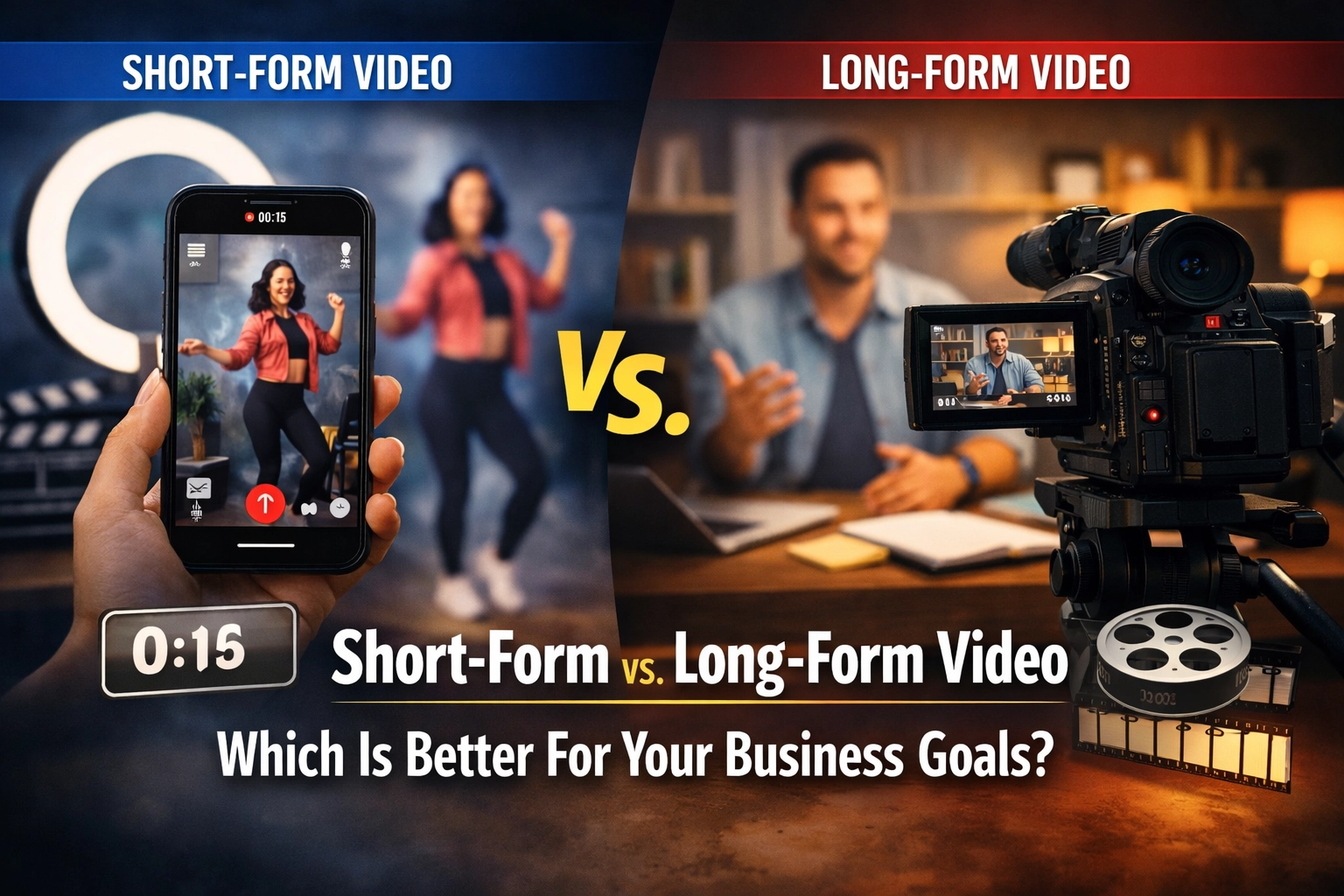
Strategy, creative thinking, industry perspective, and lessons from the work.
Work With Us ↗You've seen the stats. Short-form video is everywhere: TikTok, Instagram Reels, YouTube Shorts. Algorithms love it. Audiences scroll through it. And every marketer seems to be preaching the gospel of snackable content.
But then you look at your business goals. You need leads, not just likes. Conversions, not just comments. And you're wondering if 15-second clips can actually move the needle: or if you need something with more depth.
Here's the truth: the answer isn't about which format is "better." It's about which format serves your specific business goals. And if you're building a real commercial video production strategy, you'll probably need both.
Let's break down when each format works, what it actually accomplishes, and how to decide what your business needs right now.
What Short-Form Video Actually Does Well
Short-form video: anything under 60 seconds: excels at one thing above all else: capturing attention fast. It's built for the scroll. Your audience isn't settling in to watch. They're moving, deciding in seconds whether to stop or keep going.
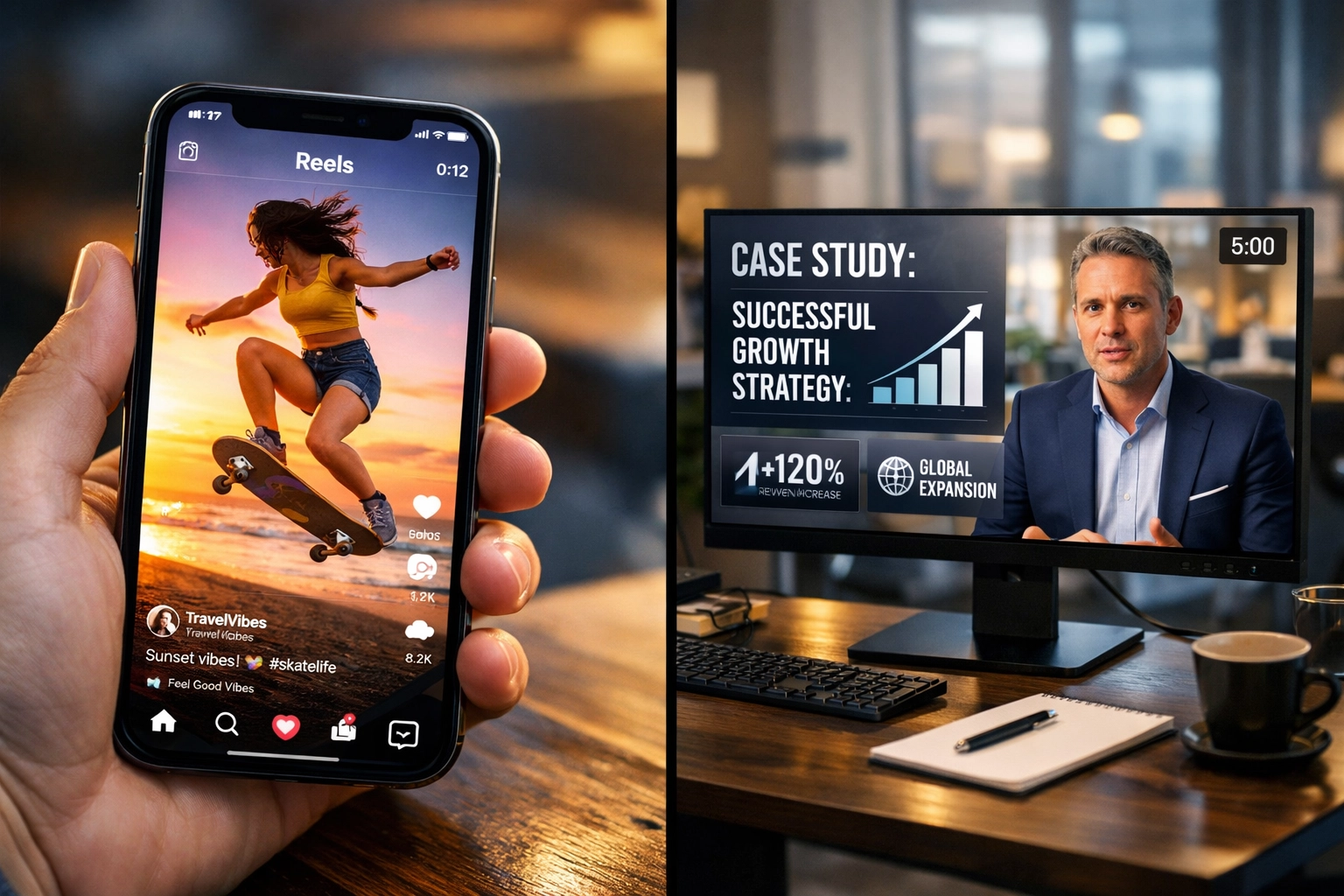
That makes short-form ideal when your goal is awareness and reach. You're trying to get in front of new audiences, remind existing ones you exist, or create a moment of quick engagement. It's the top of your funnel. The handshake, not the pitch meeting.
Here's where short-form wins:
- Social media video ads that need to stop the scroll in under three seconds
- Brand awareness campaigns that prioritize reach over depth
- Announcements, updates, or quick tips that don't require explanation
- Mobile-first content consumed on the go
- Testing messaging or creative concepts before committing to bigger production
Short-form is also cheaper and faster to produce. You can create more of it, iterate quickly, and flood your channels without a massive production budget. The format rewards consistency: posting regularly matters more than perfection.
But here's the limitation: short-form rarely drives conversions on its own. It's not built to explain, educate, or establish authority. You're not closing a deal in 30 seconds. You're planting a seed.
What Long-Form Video Actually Accomplishes
Long-form video: anything over two minutes, often stretching to 5, 10, or even 20 minutes: serves a completely different purpose. It's not about grabbing attention. It's about holding it long enough to build trust, demonstrate expertise, and move someone toward a decision.
When you need depth, long-form delivers. It lets you tell a complete story, walk through a process, showcase results, and answer objections before they're even asked. That's why it performs when your goal is conversion, credibility, or education.

Here's where long-form wins:
- Case studies and client success stories that prove ROI
- Product or service explainers that need to show how something works
- Thought leadership content that positions your company as an expert
- Testimonial films that let real customers tell their full story
- Educational content that lives on your website, YouTube, or LinkedIn
Long-form also has serious SEO advantages when it's part of your website strategy. A well-placed long-form video can keep people on the page longer, support the topic with on-page copy (headings, FAQs, transcripts, and internal links), and give search engines stronger engagement signals over time. That translates to more qualified organic traffic—and content that keeps working months after you publish it.
And when it comes to commercial video production, long-form is where you showcase what you're capable of. It's the place to demonstrate your strategic thinking, production quality, and storytelling ability: all the things that differentiate you from everyone with a smartphone and a Ring light.
The trade-off? Long-form requires more investment: time, planning, and production resources. It's also harder to get someone to commit to watching. You need to earn their attention up front and keep earning it throughout.
The Real Question: What Are You Trying to Accomplish?
Most businesses ask, "Should we do short-form or long-form?" The better question is: "How does this format fit into our broader marketing strategy?" Because the real win isn't choosing a length. It's building a system where every video supports the next step.
If you're trying to generate leads, that system often looks like this: short-form earns the click, long-form earns the trust, and your website does the conversion work.
Think of it as a content ecosystem:
- Short-form drives traffic from social. You're showing up in-feed, making a clear promise fast, and giving people a reason to tap through to learn more.
- Long-form supports SEO on your website. When you embed a video on a relevant page (service page, case study, blog post), you can increase time on page, strengthen topical relevance with supporting copy, and create an asset you can internally link to across your site.
- Both formats work together. A 20-second teaser on Instagram can push someone to a 5-minute case study on your site. That case study can rank in search, build confidence, and guide them to a contact form or next step. One feeds the other.

The businesses seeing the best results from video aren't choosing one format. They're using both strategically, with each piece of content serving a specific role in the customer journey.
How to Decide What Your Business Needs Right Now
Start by mapping your content to your funnel. Ask yourself:
- Where are most of your prospects when they find you? If they've never heard of you, short-form helps with discovery. If they're already considering you, long-form moves them closer to a decision.
- What's your biggest gap right now? Not enough traffic? Focus on short-form reach. Plenty of traffic but low conversions? You probably need long-form content that builds trust and answers objections.
- What platforms matter most to your audience? If you're targeting B2B decision-makers on LinkedIn, long-form performs well there. If you're chasing younger consumers on Instagram, short-form dominates.
Then think about your capacity. You don't need to be everywhere at once. It's better to do one format well than to spread yourself thin trying to execute both poorly.
If you're just getting started, here's a practical approach:
- Start with one hero piece of long-form content: a case study, a service explainer, or a testimonial film. Something that lives on your website and does the heavy lifting of building credibility.
- Cut it into short-form pieces for social. Pull quotes, key moments, behind-the-scenes clips. One long-form shoot can generate weeks of short-form content.
- Test and track what moves the needle. Are people watching the full video? Are they clicking through? Are they reaching out? Let the data guide where you invest next.
This approach maximizes ROI. You're not creating content for content's sake. Every piece has a purpose, and each format supports the other.
Where Commercial Video Production Fits In
If you're serious about using video to drive business results, production quality matters: but not in the way most people think. You don't need Hollywood-level production for a 15-second Instagram Reel. But you do need clarity, good audio, and a message that lands in three seconds.
And when it comes to long-form? That's where professional commercial video production makes the biggest difference. A 5-minute case study only works if it's compelling start to finish. Loose pacing, bad sound, or amateur editing will lose viewers before you make your point.

The best video strategies combine smart creative thinking with the right production approach for each format. Short-form can be nimble and fast. Long-form needs structure, story, and polish. And the real lever is integration—video, web, and SEO working together.
That's where our Strategy First approach comes in. We don't just ask, "What should you film?" We look at the whole path: what you're posting on social to drive traffic, what that traffic lands on, and how your long-form video and page structure support SEO and conversions. It's holistic marketing consulting, not a one-off deliverable.
Final Thoughts: Stop Choosing, Start Strategizing
Short-form video isn't "better" than long-form, and long-form isn't "better" than short. They're tools, and the right tool depends on the job you're trying to do.
If you want reach and awareness, short-form gets you there. If you want credibility and conversions, long-form closes the gap. And if you want a system that consistently attracts, nurtures, and converts the right customers, you need both working together.
The businesses winning with video aren't following trends. They're building strategic content ecosystems that guide prospects from first impression to final decision. And they're backing it up with production quality that makes every frame count.
If you're ready to build a video strategy that actually drives results: not just views: let's talk. We help businesses create content that works across every format, every platform, and every stage of your funnel.