Strategy, creative thinking, industry perspective, and lessons from the work.
Work With Us ↗You’ve seen the headlines. You’ve probably seen the ads too, the ones promising that you can build a multi-million dollar brand, a cinematic masterpiece, and a high-converting website just by typing a single sentence into a chat box. It’s tempting to believe the hype. After all, who wouldn't want a "one-click" solution to the hardest parts of running a business?
But here’s the reality you’re likely already sensing: a tool is only as good as the person holding it. At South Town Productions, we’ve spent the last year aggressively integrating AI into our workflow, not because we want to replace the human element, but because we want to supercharge it. We’re doing a deep dive into our own internal processes to show you exactly where AI wins, where it fails miserably, and why "strategy first" is still the only way to survive the coming shift in how the world finds information.
The Eight-Template Fail: Why One-Click AI Builders Are a Myth
Let’s start with the "fail" because it’s a lesson in frustration. Recently, we decided to stress-test the new AI website builders hitting the market. You know the ones, platforms like Wix are now integrating ChatGPT directly into their interface, promising to "design your site" through a simple conversation.
I tried it. Not once. Not twice. I tried it eight separate times.
Each time, I gave the AI a specific prompt about what we do, our focus on marketing strategy, our background in cinematic storytelling, and our shift toward AI search optimization. And eight times in a row, I opened my account to find a graveyard of bare-bones templates. They weren't just simple; they were empty shells. No copy that converted, no strategic layout, and certainly no "soul."
It’s like asking a microwave to cook you a five-course gourmet meal. Sure, it can heat things up, but it has no concept of flavor, texture, or presentation. If you’re looking for a digital paperweight, use a one-click AI builder. If you’re looking for a digital presence that actually moves the needle, you still need a human architect.
Shifting the Goalposts to AI Search Optimization (AISO)
While we don't trust AI to build the house, we absolutely trust it to help us map out the neighborhood. The biggest shift we’ve made at South Town is moving beyond traditional SEO into the world of AI Search Optimization (AISO).
You already know how Google works: or at least, how it used to work. You type in a keyword, and you get a list of blue links. But that’s changing fast. With the rise of Search Generative Experience (SGE) and AI-driven answer engines, people aren't just looking for links anymore; they’re looking for answers.
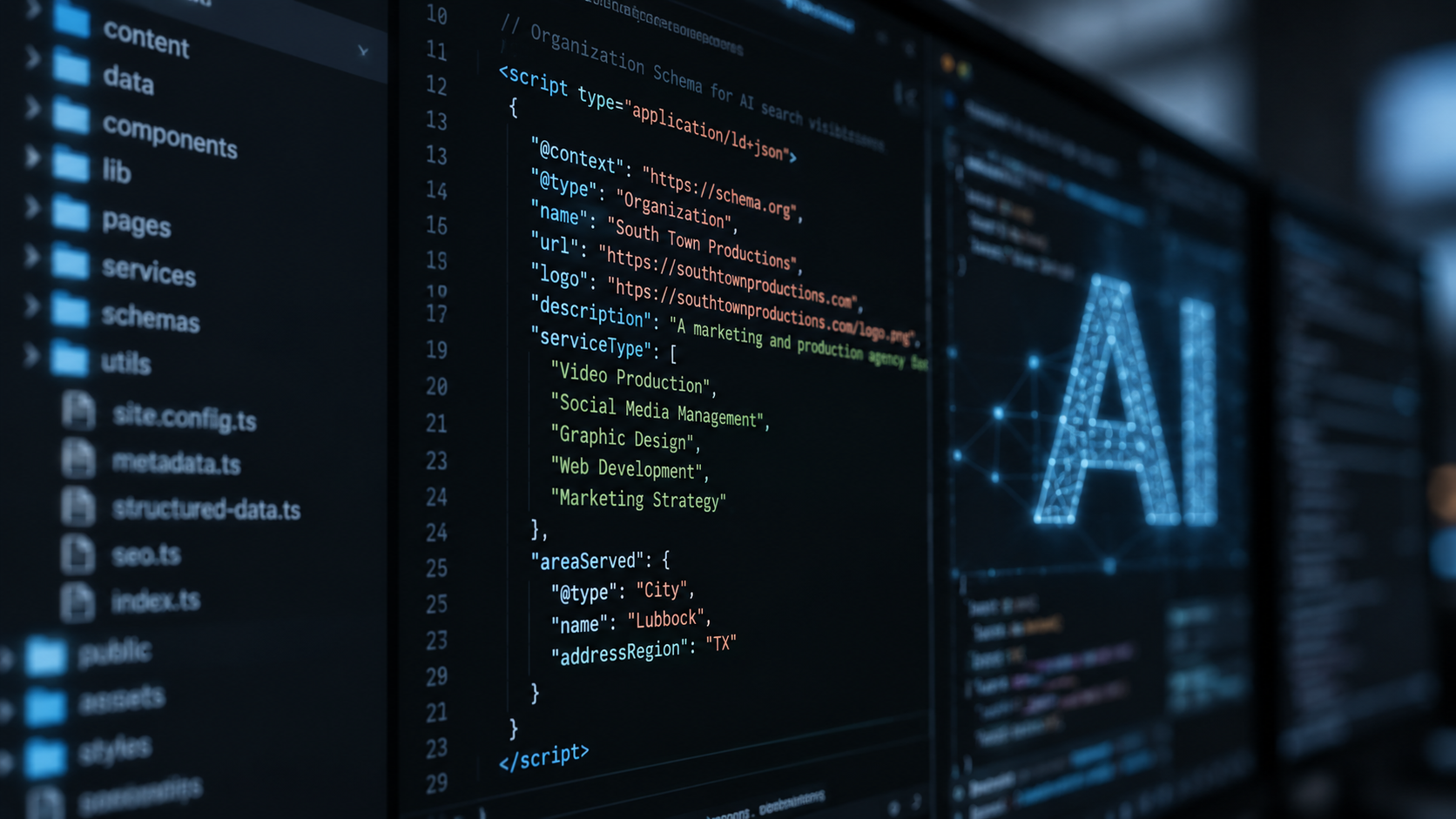
We’ve pivoted our internal SEO strategy to ensure our content (and yours) is "AI-ready." This means optimizing for how LLMs (Large Language Models) pull data. We aren't just stuffing keywords into a paragraph. We’re structuring data so that when an AI bot is asked, "Who is the best strategic marketing agency in the South?" it has every reason to cite us.

AI is the Research Assistant, Not the Creative Director
So, how do we actually use these tools? We treat AI as the ultimate research assistant.
Before we start any project: whether it’s a video breakdown or a full brand overhaul: we use AI to crunch massive amounts of data. It helps us identify gaps in your competitors' messaging and find the "white space" your brand can own. Done right, this saves dozens of hours of manual labor, allowing us to spend more time on the stuff that actually matters: the creative.
But here’s the catch. AI can tell you what people are searching for, but it can’t tell you why they care. It can’t feel the tension in a room during a cinematic interview. It doesn't understand the nuance of a nonprofit's mission or the grit required to build a legacy brand.
We use AI to find the "what," but we rely on our human team to define the "how" and the "why." That’s where the magic happens.
Strategy First: The Antidote to "Bare-Bone" Results
Most agencies are panicking right now because their entire business model is built on "doing things" that AI can now do for free. If your value is just "writing a blog post" or "coding a basic page," you're in trouble.
At South Town, we’ve always leaned into marketing strategy as our foundation. AI can generate text, but it can't generate a cohesive business strategy that connects your film content, your web design, and your long-term growth goals.
When we build an "AI-ready" website, we’re looking at it through a lens of branding and messaging. We’re asking:
- Does this site load fast enough for AI crawlers?
- Is the content authoritative enough to earn a citation?
- Does the user experience lead to a conversion, or is it just a pretty distraction?
Most importantly, we ensure that the human oversight is visible. In an era where the internet is about to be flooded with "average" AI content, high-quality, human-led storytelling is becoming the ultimate premium asset.

The Human Oversight Era
We’re officially in the era of human oversight. This means that your job: and ours: is no longer just to "create." It’s to curate, direct, and refine.
Think about it like this: if everyone has access to the same AI tools, then the tools themselves provide zero competitive advantage. The advantage comes from the strategy you apply to those tools. It’s about knowing when to let the AI handle the heavy lifting of data and when to step in with a human hand to ensure the final product doesn't feel like a soulless template.
Whether we are working on nonprofit marketing or a high-end commercial shoot, we use AI to optimize the process, but we never let it drive the car. We’ve seen what happens when you let the bot drive: you end up with eight empty Wix templates and a whole lot of wasted time.

Future-Proofing Your Brand
So, what does this mean for you? It means you don't need to fear AI, but you do need to be skeptical of anyone selling it as a total replacement for expertise.
The goal of our internal case study was to prove that even a tech-forward agency like ours still finds the most value in human connection and strategic thinking. We’re doubling down on AISO and AI-ready infrastructure because that is how you stay visible in 2026 and beyond. But we’re also doubling down on our services that require a pulse: like cinematic video and deep-dive consulting.
The "bare-bone" era of the internet is coming. Don't let your brand be part of it.

Final Thoughts
The landscape of search and web design is shifting beneath our feet, and while AI is a powerful ally, it’s a terrible master. You need a partner who understands how to leverage these new tools without losing the unique voice that makes your business worth finding in the first place.
If you’re ready to move past the "bare-bones" templates and build a strategic, AI-ready presence that actually converts, let’s talk about your strategy.